
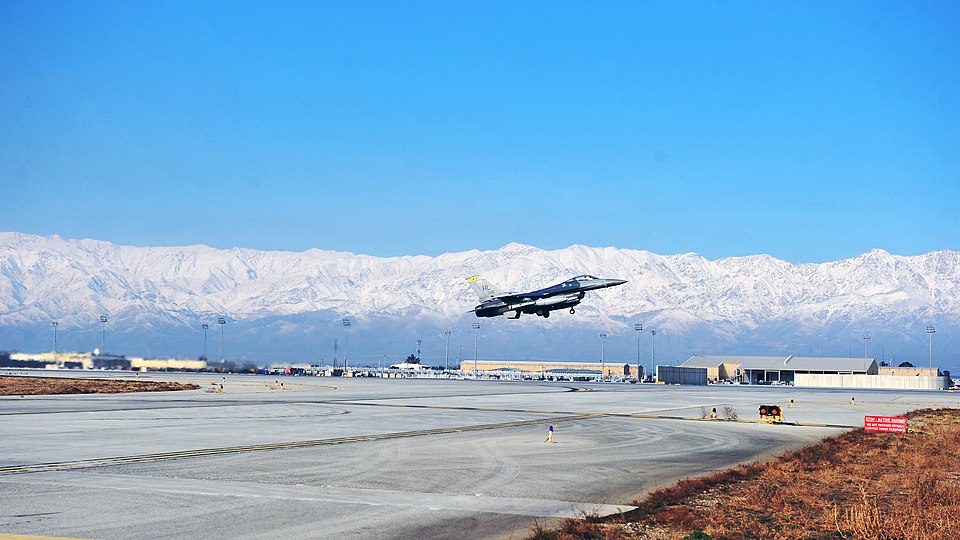
Bagram Airfield, with its two large concrete runways—the main runway being approximately 3,600 meters long—and infrastructure including multiple large hangars, a control tower, over 13 hectares of ramp space, and more than 110 aircraft shelters, represents one of the few key strategic points in Afghanistan capable of accommodating heavy transport aircraft and providing operational support. From a capacity perspective, it enables the simultaneous functions of logistics, command-and-control, medical support, and engineering operations. These technical specifications, reflected in maps and technical reports, transform Bagram into a strategic hub north of Kabul. From a strategic standpoint, the ability to host heavy aircraft and the considerable space available make Bagram a focal point that is important not only for military operations but also for counter-terrorism missions, humanitarian aid, and extra-regional logistics. Therefore, Donald Trump’s recent statements during his visit to Britain regarding the recapture or joint use of this airport represent the potential return of influential power projection at the regional operational level. Consequently, monitoring and observing the surrounding security equations holds strategic importance for Iran.
Assessing America’s Efforts to Revive Bagram
Public statements by the President of the United States and media reports indicate that Washington has pursued at least some discussions about returning to Bagram in recent months; some reports speak of behind-the-scenes negotiations and exchanges of views. However, the Taliban has explicitly rejected this idea, describing it as contrary to national sovereignty and the Doha Agreements. This rhetorical confrontation demonstrates the deep gap between Washington’s operational logic and the Taliban’s political-symbolic logic. There are also discrepancies in the details of the claims: reports have emerged about a monthly financial proposal from America with asymmetric figures (amounts that in some reports are cited as $300,000 and in others reflect contradictory claims); however, credible media sources have emphasized the principle of discussions and the Taliban’s rejection while refraining from providing definitive meaning of agreement or handover. Therefore, until an official document is published, one must distinguish between discussion/pressure and an implemented agreement.
Why Bagram Matters
If we examine this through the lens of a classical approach to power, control of key infrastructure such as Bagram represents both a symbol of legitimacy and an instrument of hard power. Recapturing Bagram for Washington would serve not merely as a territorial achievement, but as a signal of the return of capacity demonstrating influence in Asia—a message sent to rivals such as China and Russia, as well as to regional neighbors Pakistan and Iran. Modern geopolitical science also emphasizes that logistical nodes in the international system have a kind of multiplier effect: that is, their capture or control can produce disproportionate power regarding force concentration and political mobility. Moreover, when the limited operational capabilities of foreign powers in the post-war order—resulting from accepting defeat in war—become apparent, the tendency to recreate power emerges again. Similar examples of this phenomenon include America’s withdrawal from Clark Base in the Philippines in 1991 and its return through the Enhanced Defense Cooperation Agreement in 2014, or the withdrawal from Iraq in 2011 and the renewed return in 2014 under the pretext of the emerging “ISIS” threat, or the Falklands example in 1982, and earlier, the Suez Crisis, each of which came with different costs and chances for interested countries. Thus, America’s re-entry into Bagram will be accompanied by moral and political costs domestically and internationally, as the memory of the 2021 withdrawal and its human and financial costs remains alive in global public opinion and in the political institutions of the United States. This theory emphasizes that field achievements without political backing will not be sustainable in the long term.
Realistic Scenarios from Iran’s and the Region’s Perspective
First: Managed Compromise Centered on Regional Actors
Any limited agreement between the United States and the Taliban must be carefully examined. If Washington can achieve joint use of Bagram through the mediation of some regional governments or the United Nations, undoubtedly an airbase in the heart of Central Asia will once again become a logistical and intelligence arm of the United States—something that directly affects Iran’s surrounding security equations. Such an agreement, even if introduced as humanitarian operations, would practically restore America’s aerial surveillance and electronic eavesdropping capabilities and could challenge Tehran’s deterrence balance on its eastern borders. From this perspective, a Washington-Taliban compromise is not a technical occurrence, but a geopolitical warning bell for Iran and other regional countries.
Second: Deepening Taliban’s Ties with America’s Rivals and Power Balance Realignment
The second scenario, which also seems more likely, is the continuation of the deadlock between Washington and the Taliban—a deadlock that will push the Taliban increasingly toward Moscow and Beijing. This path, while containing America’s direct influence, has dual consequences for Tehran: on one hand, the pronounced presence of China and Russia around Afghanistan can serve as a soft wall against Western military return; on the other hand, the Taliban’s excessive dependence on the East could transform Afghanistan into an arena of intense competition between emerging powers and threaten Iran’s security perimeter from a new angle. In this case, Tehran must, through active diplomacy and multi-layered border cooperation, prevent the formation of arrangements that would sacrifice its long-term interests to Moscow’s or Beijing’s balance-making.
Third: Intensification of Covert Competitions and Proxy Conflicts
The third possibility is the United States’ turn to indirect instruments, from intelligence influence to support for local groups. Such an approach would transform Afghanistan into a new arena of proxy conflicts—a situation that both increases Iran’s border instability and raises the Islamic Republic’s security costs in the country’s east. In this case, Tehran must simultaneously pursue two paths: strengthening security infrastructure at the border and expanding dialogue with all political and ethnic spectrums of Afghanistan to prevent the crisis from turning into a new wave of migration and smuggling.
Strategic Recommendations for Iran
Iran must understand that any kind of American operational return to Bagram, even under the cover of humanitarian missions, reactivates the capacity for intelligence influence, reconnaissance flights, and rapid movement of Western forces over a wide radius. Accordingly, Tehran can design ways of political pressure and containment by using diplomatic tools, especially closer cooperation with the Shanghai Cooperation Organization and dialogue with Central Asian neighbors. This approach, in addition to preventing Western re-establishment, also strengthens opportunities for convergence with regional powers.
Regardless of Bagram’s fate, Afghanistan under Taliban rule is Iran’s current geopolitical reality. Regular dialogues with Taliban leaders and neighbors are essential. In addition to the Bagram issue, this direct engagement can help manage vital issues such as Helmand River water, combating drug transit, and controlling migration waves.
Although relations with Russia and China have obvious advantages for limiting American influence, Iran’s foreign policy should not be reduced to merely balance-seeking ties. Forming flexible and issue-based coalitions with Central Asian countries, Pakistan, and even India can increase the diversity of options and prevent monopolization of decision-making by any power in Afghanistan’s equations.
Ultimately, what makes Iran’s security sustainable is reliance on domestic capacities. Strengthening eastern radar systems, expanding border guard infrastructure, and creating logistical centers in the country’s east is a strategy that allows Tehran to maintain its security balance even in case of unwanted developments in Bagram.
Conclusion
A realistic understanding of current dynamics suggests that recapturing Bagram is more than just a financial transaction—it is a symbolic and strategic battle that redefines Afghanistan’s security, diplomatic, and economic ties with regional actors. Washington is in a difficult position: it must either accept the high cost of direct presence or attempt to maintain its operational influence through complex diplomacy and multilateral schemes. The Taliban, motivated by preserving internal legitimacy and continuing geopolitical benefits, makes acceptance of superficial proposals unlikely. Therefore, precise cost-benefit analysis and movement based on a combination of soft and hard leverage with transparent international guarantees is the only concrete way forward. Bagram is not merely an Afghan-American issue, but a symbol of the continuation of great power competitions on the margins of regional countries’ borders. Any development at this airport, whether America’s limited return or the Taliban’s complete turn toward Moscow and Beijing, directly affects the security, economy, and regional position of regional countries and Iran. The winning strategy for Tehran is a combination of smart diplomacy, active presence in Central Asian equations, and sustainable strengthening of internal defense capabilities—an approach that can provide a real safe margin for Iran’s national interests against any scenario from tactical compromise to proxy conflict.
References
- Al Jazeera. (2025, September 6). Taliban rejects reported US offer to regain Bagram air base. Retrieved from https://www.aljazeera.com/news/2025/9/6/taliban-rejects-reported-us-offer
- BBC News. (2025, September 7). Afghanistan: US bid to re-enter Bagram base denied by Taliban. Retrieved from https://www.bbc.com/news/world-asia-66742899
- CNN. (2025, September 8). Trump’s disclosure on Bagram negotiations underscores US strategic concerns. Retrieved from https://edition.cnn.com/2025/09/08/politics/trump-bagram-taliban
- Institute for the Study of War. (2024). Afghanistan security and strategic infrastructure report. Retrieved from https://www.understandingwar.org/report/afghanistan-security-infrastructure
- Reuters. (2025, September 19). U.S. talks with Taliban to reestablish Counterterrorism forces at Afghan base: WSJ. Retrieved from https://www.reuters.com/world/asia-pacific/us-talks-with-taliban-re-establishing-counterterrorism-forces-afghan-base-wsj-2025-09-19/
- The Guardian. (2025, September 18). US seeking to regain control of Afghanistan’s Bagram airbase, says Trump. Retrieved from https://www.theguardian.com/us-news/2025/sep/18/us-seeking-to-regain-control-of-afghanistans-bagram-airbase-says-trump
- Council on Foreign Relations (CFR). (n.d.). War in Afghanistan. Global Conflict Tracker. Retrieved from https://www.cfr.org/global-conflict-tracker/conflict/war-afghanistan
- World Bank. (2023). Afghanistan economic monitor: Post-2021 developments. Retrieved from https://www.worldbank.org/en/country/afghanistan/publication/economic-monitor-2023
- United States Air Force. (2021). Bagram Airfield capabilities and infrastructure overview. Retrieved from https://www.af.mil/News/Article-Display/Article/2714554/bagram-airfield-overview