By: Parsa Akhlaghi, PhD Candidate in Russian Studies, Department of European Studies, Faculty of World Studies, University of Tehran
Introduction
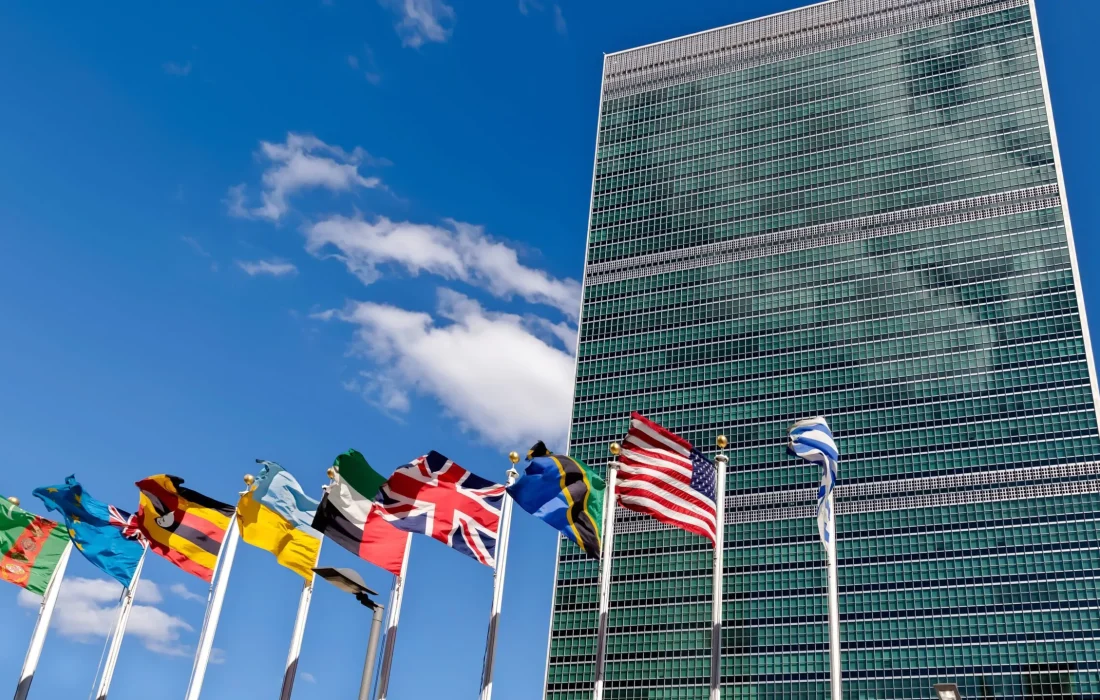
The United Nations, established after the Second World War, remains the most universal institution tasked with maintaining international peace and security. Eight decades later, it faces a deep legitimacy crisis. The geopolitical landscape has shifted from the bipolarity of the Cold War and the brief unipolar moment that followed toward an emerging multipolar order. The great-power consensus that once underpinned the UN’s authority has eroded, while the Security Council now mirrors rather than mitigates systemic rivalries.
Designed to restrain power politics, the UN increasingly operates within their renewed ascendancy. The return of great-power competition and the fragmentation of global governance have raised doubts about its capacity to act as a guarantor of peace.
Drawing on neoclassical realism, this essay examines how systemic shifts and national perceptions among major powers shape the UN’s effectiveness. It asks: How can the United Nations sustain legitimacy and functionality amid renewed rivalry and multipolar consolidation?
The hypothesis argues that the UN’s future as a guarantor of peace depends on adapting to multipolar realities and equitably recognising sovereign interests—restoring balance between legitimacy and power within the Charter framework.
Theoretical Framework and Conceptual Foundations
This study adopts neoclassical realism as its analytical framework. Developed in the 1990s as a bridge between structural realism and foreign policy, it explains state behaviour through the interaction of systemic pressures and domestic perceptions. As Gideon Rose (1998) argued, systemic constraints shape behaviour, yet policy outcomes depend on how leaders interpret them through institutions and identity.
Ripsman, Taliaferro, and Lobell (2016) expanded this into a multi-level model linking material power with ideas and institutions. In the UN context, the framework clarifies why identical Charter provisions yield divergent practices: the organization mirrors both power hierarchies and the perceptions of its major members.
Barry Buzan’s multi-layered security concept extends this logic. Security spans individual, state, and systemic levels, across political, military, and societal dimensions. Institutional legitimacy thus becomes a form of security — a stabilizing consensus on rules that restrain coercion.
The UN’s present challenges are therefore not institutional failure but misaligned perceptions among great powers within a shifting balance of capabilities. This framework bridges power politics and institutional effectiveness, forming the study’s analytical core. This theoretical lens provides the basis for analysing how the UN’s institutional evolution mirrors the dynamics of great-power rivalry in practice. In this sense, legitimacy itself becomes a form of security: the collective confidence that power will be exercised within accepted norms.
The United Nations and the Dynamics of Great-Power Rivalry
The 1945 UN Charter placed collective security at the centre of the post-war order. Articles 1 and 2 affirmed peace and sovereign equality, yet these ideals were never immune to power realities. From the start, the Security Council embodied a compromise among the war victors, and the veto—meant to ensure participation—also entrenched inequality within the very body charged with upholding equality.
Today this compromise is increasingly untenable. The UN Security Council Report 2024 shows fewer Chapter VII resolutions and more vetoes. Crises from Ukraine to Gaza and Sudan expose its paralysis. At the 2023 Doha Forum, Secretary-General António Guterres warned that the Council is “paralysed by divisions” and that global governance is failing to confront new technological and environmental threats. His call for “deep reforms” reflected recognition that the core problem lies not in institutional design alone but in the erosion of political consensus among major powers.
From a neoclassical-realist view, the stalemate reflects a gap between systemic change and elite perceptions. The unipolar moment has yielded to diffuse multipolarity, yet the Council’s logic remains anchored in 1945. The United States still treats the UN as a vehicle for legitimising its leadership; China and Russia see it as a bulwark of sovereignty and legal restraint. Russia’s Foreign-Policy Concept (2023) defines it as a “sovereign centre of world development” and insists that genuine multipolarity must rest on the Charter, not on alternative “rules-based” schemes.
Divergent perceptions turn the UN from a platform of consensus into an arena of contestation. Neoclassical realism shows that shifting capabilities matter less than how elites interpret them—cooperation where interests align, obstruction where they clash. Still, the UN’s endurance proves its residual legitimacy: as Guterres noted, no state can manage crises alone. The task is not to replace the UN but to reconcile its universal ideals with the power realities of a multipolar age.
Russia’s Vision of Multipolarity and Institutional Legitimacy
Russia’s foreign-policy doctrine places the UN at the core of an emerging multipolar order. The Foreign-Policy Concept (2023) calls Russia a “sovereign centre of global development” and upholds the Charter as the “foundation of a just world order.” Moscow argues that reviving post-1945 institutions through broader representation and respect for sovereignty is essential to international stability.
In statements at the 78th and 80th UN General Assemblies, Foreign Minister Sergey Lavrov warned that attempts to impose a “rules-based order” erode sovereign equality. For Russia, the UN is not outdated but the last forum where major powers can reconcile interests without coercion. In 2024 Security Council debates Moscow again urged broader representation for Asia, Africa, and Latin America while preserving the Council’s authority.
Analysts at the Valdai Club and RIAC describe this approach as a re-balancing of power and legitimacy. Ivan Timofeev links multipolarity to institutional renewal; Andrey Kortunov sees Russia seeking equilibrium among civilizational centres; even Sergei Karaganov’s “civilizational realism” frames deterrence and regional integration as strategic restraint.
From a neoclassical-realist view, Russia’s stance joins structural change with perception: the diffusion of power demands institutional pluralism, while elites elevate this need into a normative principle. Linking power with legal equality, Moscow presents the UN as both symbol and instrument of a multipolar balance where sovereignty and legitimacy coincide.
Paths to Reform and the Future of Collective Security
UN reform has long been debated but is now urgent amid the erosion of collective security. The Our Common Agenda (2021) and the planned Summit of the Future urge “networked multilateralism.” Western experts, including Stewart Patrick and Minh-Thu Pham, note that a Council frozen in 1945 realities undermines legitimacy and efficiency. They call for adding members from Asia, Africa, and Latin America and for greater transparency and accountability.
Moscow also supports reform but with a different focus. In his 2024 and 2025 UNGA statements, Sergey Lavrov insisted that legitimacy stems from sovereign equality, not ideology or majority rule. RIAC and Valdai analysts add that real reform must link legality with multipolarity, keeping the UN the main coordinator rather than replacing it with ad hoc “rules-based” groups.
From a neoclassical-realist view, reform must align legitimacy with shifting power perceptions. The Council will work only if great powers see its rules as compatible with their core interests. A UN that integrates new centres of influence while upholding the Charter’s universality could restore balance between law and power, sustaining its role as guarantor of peace in a multipolar world. The participation of emerging powers and the Global South is central to this process. Their inclusion would not only democratise decision-making but also reinforce the UN’s claim to universality.
Conclusion
Eighty years after its founding, the United Nations stands at a crossroads between obsolescence and renewal. Its legitimacy crisis is not simply institutional but systemic, reflecting the broader transformation of the international order. From a neoclassical realist perspective, the UN’s challenges arise from the disjunction between changing power structures and the perceptions of those who command them. The paralysis of the Security Council illustrates that no collective mechanism can function when its members diverge on the meaning of legitimacy itself.
Yet the UN’s endurance also reveals a persistent truth: even in a fragmented world, states continue to seek a universal framework for coexistence. A balanced adaptation—anchored in the Charter, responsive to multipolar realities, and grounded in sovereign equality—can restore the UN’s capacity to act as a guarantor of peace. The organization’s renewal will not emerge from abstract idealism but from the pragmatic recognition that legitimacy and power must once again converge within a shared institutional order. If the UN adapts with balance and humility, it may yet fulfil its founding promise: to preserve peace not by domination, but through shared responsibility among equals.
References:
Buzan, B. (1991). People, states and fear: An agenda for international security studies in the post-Cold War era (2nd ed.). Lynne Rienner Publishers.
Guterres, A. (2023, December). Remarks at the Doha Forum on global governance and Security Council paralysis. United Nations. https://www.un.org
Karaganov, S. (2023). A difficult but necessary decision. Russia in Global Affairs. https://eng.globalaffairs.ru
Kortunov, A. (2024). Multipolarity and equilibrium among civilizational centres. Russian International Affairs Council (RIAC). https://russiancouncil.ru
Ripsman, N. M., Taliaferro, J. W., & Lobell, S. E. (2016). Neoclassical realist theory of international politics. Oxford University Press.
Rose, G. (1998). Neoclassical realism and theories of foreign policy. World Politics, 51(1), 144–172. https://doi.org/10.1017/S0043887100007814
Russian Federation Ministry of Foreign Affairs. (2023). The concept of the foreign policy of the Russian Federation. https://mid.ru
Russian Federation Ministry of Foreign Affairs. (2023). Statement by Foreign Minister Sergey Lavrov at the 78th session of the United Nations General Assembly. https://mid.ru
Russian Federation Ministry of Foreign Affairs. (2025). Remarks by Foreign Minister Sergey Lavrov at the 80th session of the United Nations General Assembly. https://mid.ru
Timofeev, I. (2024). Multipolarity and institutional renewal in the international system. Valdai Discussion Club. https://valdaiclub.com
United Nations. (1945). Charter of the United Nations. https://www.un.org/en/about-us/un-charter
United Nations. (2021). Our common agenda: Report of the Secretary-General. https://www.un.org
United Nations Security Council. (2024). Annual report of the Security Council. United Nations. https://www.un.org/securitycouncil