Parsa Akhlaghi – Secretary of the Russia Studies Research Group at IRAS ;PhD Candidate in Russian Studies, Department of European Studies, Faculty of World Studies, University of Tehran (IRAN)
A Predictable Victory, a More Consequential Mandate
United Russia (Единая Россия) did not need the September 2026 election to prove that it remained Russia’s dominant political party. No national rival entered the campaign with a realistic prospect of taking control of the State Duma (Государственная Дума), and few observers expected the governing party to lose its majority. What the election could still reveal was whether that dominance remained politically productive. Could the authorities bring voters to the polls after several years of war, sanctions and economic adjustment? Would United Russia merely retain its existing position, or improve it? And would the parliamentary opposition absorb public dissatisfaction or lose further ground? Seen in this light, the result was more consequential than the predictability of the winner initially suggested. The election did not change who governed Russia, but it strengthened the institutional terms on which the country would be governed.
That is the central argument of this report. Russia’s 2026 parliamentary election was an exercise in adaptive consolidation: the governing centre used an established electoral system to mobilise participation, reinforce its majority and renew part of the political class without opening the foundations of national power to serious competition. This does not make the election meaningless. It means that its significance lies somewhere other than a possible transfer of government. The vote tested organisational reach, measured the relative standing of the recognised parties and determined how much parliamentary room the governing party would possess during the next phase of the conflict. Those were limited questions compared with a fully open contest for executive power, but they were not trivial ones.
The setting gave them additional weight. Voting took place from 18 to 20 September, making this the first State Duma election since the large-scale expansion of the Russia–Ukraine war in February 2022. By 2026, the conflict was no longer experienced by Russian society only through television coverage or foreign-policy statements. Military casualties, sanctions, defence spending, drone attacks and heightened security measures had brought it closer to everyday life. The election also included voting in the Donetsk, Luhansk, Zaporizhzhia and Kherson regions, which Russia incorporated in 2022. Russia regards these territories as federal subjects; Ukraine and most members of the international community do not recognise that status. The election therefore unfolded inside a domestic legal framework whose territorial application remained disputed internationally.
The campaign was not formally organised as a referendum on the war. Nor did the ballot offer voters a simple division between continuing the conflict and ending it. The parties differed over social spending, taxation, regional development, migration, economic regulation and the performance of individual officials, but the parliamentary contenders did not present fundamentally opposed positions on the structure of presidential authority or the main direction of national security policy. Continuity was therefore built into the field of competition before voting began. The genuine uncertainty concerned the distribution of support inside that field: which party would become the principal opposition force, whether New People could consolidate its place in parliament, and whether A Just Russia could remain above the electoral threshold.
Ten federal party lists took part in the election, and five received more than the 5 percent required for proportional representation. Competition was visible, but it was plainly asymmetrical. United Russia entered the campaign with deeper regional organisation, more incumbent officeholders and much closer ties to federal and regional administrations than any rival. The federal list of the liberal Yabloko party (Российская объединённая демократическая партия «Яблоко») was removed after a judicial challenge brought by Rodina (Родина), further reducing the range of positions represented in the nationwide party-list contest.[3] The removal followed a legal process, and this report does not presume that the court’s decision was politically dictated. Its political effect, however, was clear: voters critical of the broader direction of state policy had fewer organised choices on the federal ballot.
Within those boundaries, the final results showed considerable movement. The Central Election Commission of the Russian Federation (Центральная избирательная комиссия Российской Федерации, ЦИК России) certified United Russia’s party-list share at 58.21 percent. The Communist Party of the Russian Federation (Коммунистическая партия Российской Федерации, КПРФ) finished second with 13.47 percent, followed by the Liberal Democratic Party of Russia (Либерально-демократическая партия России, ЛДПР) on 8.88 percent, New People (Новые люди) on 7.82 percent and A Just Russia (Справедливая Россия) on 5.34 percent.[1,3] United Russia also won 209 of the 225 single-member constituencies, giving it 349 of the Duma’s 450 elected seats.[2–4] This was the largest number of seats won by the party in any State Duma election.
The result was historic in parliamentary terms, though not in every electoral measure. United Russia’s 58.21 percent party-list vote remained below the 64.3 percent it received in 2007.[3] Its achievement in 2026 was therefore not an unprecedented share of the popular vote, but the most advantageous conversion of national and constituency support into parliamentary representation in its history. That distinction matters. Describing every component of the result as a record would exaggerate the evidence; describing it as routine would miss the scale of the resulting majority. The governing party obtained more than three-quarters of the chamber from a party-list vote of slightly under three-fifths, an outcome made possible by its overwhelming success in the single-member districts. The mechanics and political consequences of that conversion will be examined in the second section.
The change from 2021 is especially revealing. United Russia’s party-list share rose from 49.82 to 58.21 percent—an increase of 8.39 percentage points. During the same period, national turnout rose from 51.72 to 59.8 percent.[3,4] In other words, greater participation did not dilute the governing party’s advantage. It coincided with a substantially stronger result for it. This does not prove that every additional voter supported United Russia, nor can aggregate totals establish why individuals voted as they did. It does show that the larger electorate did not produce the kind of protest surge that might have narrowed the party’s lead. Whatever dissatisfaction existed over inflation, wartime costs, local governance or social policy, the parliamentary opposition was unable to combine it into a broader challenge.
The opposition results add an important qualification. United Russia’s expansion did not eliminate electoral movement; it redirected it. The Communist Party fell from 18.93 percent in 2021 to 13.47 percent, surrendering much of the protest support it had gathered in the previous election. By contrast, the LDPR rose from 7.55 to 8.88 percent, while New People advanced from 5.32 to 7.82 percent. A Just Russia declined from 7.46 to 5.34 percent and came much closer to losing parliamentary representation.[1,3] The opposition electorate did not disappear, but its internal balance shifted away from the Communist Party and A Just Russia. This was more than a change in ranking. It suggested that parties presenting themselves as newer, more flexible or more closely aligned with patriotic state priorities were better placed to compete within the political atmosphere of 2026.
Turnout was therefore not a secondary statistic. A total of 67,448,094 voters participated, producing a final national turnout of 59.8 percent.[2–4] This was markedly higher than the 51.72 percent recorded in 2021 and the 47.88 percent recorded in 2016. It was also only slightly below the 60.21 percent turnout of 2011.[3] The election did not establish an all-time participation record, but it reversed the lower-turnout pattern of the previous two parliamentary cycles. That mattered because a predictable election always runs the risk of voter indifference. In 2026, nearly three-fifths of registered voters still took part. The system succeeded not merely in managing an election, but in making participation appear worthwhile to a substantially larger share of the electorate.
Several forces probably contributed to the increase. Voting was spread over three days, and remote electronic voting (дистанционное электронное голосование, ДЭГ) was available in 33 federal subjects, including Moscow’s separate system. Approximately 3.65 million voters used the federal platform, while around 3.45 million voted electronically in Moscow. Of those registered for the federal system, 90.87 percent cast a ballot.[4] Easier access almost certainly helped, although it cannot explain the entire increase because the 2021 parliamentary election had also lasted three days. The security environment may have raised the perceived importance of participation, while parties and regional administrations had strong incentives to demonstrate organisation and public engagement. Civic habit, loyalty, concern about instability and support for particular candidates may also have played a part. The available aggregate data cannot determine the exact weight of each factor.
The timing of participation nevertheless points toward the importance of organised mobilisation. Turnout reached 29.45 percent by the end of the first day, compared with 18.39 percent at the same stage in 2021.[4] Russian political specialists interviewed during the election identified early voting as the period in which party organisations and regional networks concentrated much of their mobilisation effort. United Russia possessed the widest capacity to do this, but mobilisation alone should not be confused with fabrication. Parties routinely remind supporters to vote, organise campaign workers and monitor participation. The relevant analytical point is that the governing party and its allied networks proved more effective at these tasks than their competitors. The election measured not only public attitudes, but the capacity to turn those attitudes into ballots.
For the same reason, turnout cannot be read as an exact approval rating for the government, the president or the military campaign. A ballot cast for United Russia might express support for the country’s strategic course, satisfaction with a regional candidate, preference for stability, reliance on state social programmes or some combination of these motives. Voting for an opposition party could register economic dissatisfaction without amounting to rejection of the political system. The figure of 59.8 percent is best understood as evidence of participation and mobilisation, not as a plebiscite on every government policy. Even so, it would be equally misleading to dismiss it. Under conditions in which abstention remained possible and the outcome appeared largely foreseeable, the willingness of more than 67 million citizens to take part strengthened the state’s claim that its institutions retained social reach during wartime.
The conduct of the election also reflected the pressures of that setting. The CEC reported that 36,850 ballots were invalidated at 20 polling stations in 12 regions following incidents that included ballot stuffing, damaged seals and violations of procedures for voting outside polling stations.[4] These cases confirm that irregularities occurred, but the number of affected ballots was too small to alter the national distribution of seats. Russian authorities also reported repeated cyberattacks, damage to approximately 75 election-commission buildings and the deaths of six election officials during attacks connected to the conflict.[4] Some questions of attribution cannot be verified solely from the CEC’s reporting, so these should remain identified as official findings. Their existence nevertheless helps explain why the authorities placed unusual emphasis on security, administrative resilience and the uninterrupted completion of voting.
External and domestic assessments were not fully aligned. Russia reported that 1,126 foreign observers and electoral specialists from 133 countries attended the election.[6] The 207-member Commonwealth of Independent States mission described the vote as open and competitive and said that it had not identified violations capable of changing the outcome.[8] Representatives of the parliamentary parties generally accepted the certified national result, although Communist Party leader Gennady Zyuganov questioned the exceptionally high turnout and United Russia vote shares reported in parts of the North Caucasus.[5] Russia did not, however, invite an observation mission from the OSCE Office for Democratic Institutions and Human Rights. ODIHR argued that this prevented the application of its standardised monitoring methodology and reduced the scope for an internationally comparable assessment.[7]
The evidence therefore supports a more measured judgement than either of the familiar extremes. The election produced a certified result that Russian state institutions and the participating parliamentary parties treated as the basis for forming the ninth State Duma. Documented irregularities existed, as did regional results that warrant closer examination, but the material presently available does not show that those cases determined the national winner. At the same time, the restricted field of competition and absence of an ODIHR mission place limits on broader claims about electoral openness. The most accurate description is that the vote was politically competitive inside boundaries that strongly favoured continuity. Those boundaries shaped the election, but they did not erase every choice made within them.
The result ultimately delivered something more valuable to the governing centre than another routine victory. It showed that wartime pressure had not produced electoral withdrawal, fragmentation among loyalist forces or a major parliamentary protest vote. Participation increased, United Russia’s share increased with it, and the recognised opposition was reorganised without threatening the governing majority. That is the adaptive element of consolidation: the political system preserved its basic structure while adjusting its personnel, methods of mobilisation and internal balance to a more demanding environment. The next question is how this electoral advantage was converted into institutional power—why 58.21 percent of the party-list vote yielded 349 seats, what the changing fortunes of the opposition parties mean, and whether the renewal of the ninth Duma represents substantive political change or continuity through carefully managed replacement.
From Electoral Victory to Parliamentary Power
The most consequential feature of the election was not United Russia’s 58.21 percent party-list result by itself, but the way that support was converted into control of the State Duma. Russia elects half of its 450 deputies through proportional party lists and the other half through single-member constituencies. This mixed system rewards parties that combine broad national support with strong candidates and organisations at the regional level. United Russia possessed both. It received 140 of the 225 party-list seats and won 209 of the 225 constituencies, bringing its elected total to 349.[1,2] The party therefore secured 77.56 percent of the chamber with 58.21 percent of the party-list vote. This was not a mathematical irregularity or a departure from electoral law. It was the intended effect of a mixed system operating in a political environment where one party enjoyed an overwhelming territorial advantage.
The proportional tier provided the first advantage. Only five parties crossed the 5 percent threshold, and together they received approximately 93.7 percent of the party-list vote. Once votes for parties below the threshold were excluded from the allocation, United Russia accounted for roughly 62.1 percent of the votes eligible for representation. That yielded 140 party-list seats. The much larger advantage came from the constituency contests, where the party won almost 93 percent of available mandates. Its candidates were able to draw on name recognition, regional networks, incumbent office and association with governors or federal programmes. Opposition parties could attract millions of votes nationally, yet often lacked the local concentration required to defeat United Russia candidates in individual districts. The electoral system did not create the governing party’s dominance, but it amplified it.
This amplification matters because 349 seats place United Russia well above the 300 required for a two-thirds majority in the Duma. The party can pass federal constitutional legislation through the lower chamber and exercise other qualified-majority powers without needing votes from another faction, although approval by the Federation Council or the president remains necessary where constitutionally required. Its elected majority stood 49 seats above the two-thirds threshold, giving it considerable protection against absences or occasional internal disagreement. The result thus removed any arithmetic dependence on the parliamentary opposition. Consultation may still occur for political, procedural or technical reasons, but it is not required for United Russia to prevail in a plenary vote.
The opposition’s losses were not evenly distributed. The Communist Party experienced the sharpest decline, falling from 57 seats in 2021 to 37 in 2026—its lowest representation in the history of the State Duma.[3,9] Five of those deputies won constituencies, while 32 entered through the party list. The result does not suggest that the Communist Party has ceased to matter: it remains the largest opposition faction, retains an established regional organisation and continues to attract voters dissatisfied with economic inequality and social policy. It does show that the party failed to preserve much of the wider protest constituency it had assembled in 2021. Its long-standing identity remains recognisable, but that stability can also make it difficult to reach voters looking for a newer form of opposition.
The LDPR and New People moved in the opposite direction. The LDPR won 23 elected seats, two more than in 2021, demonstrating that it could survive its first State Duma election without its founder, Vladimir Zhirinovsky. Its improvement was modest, but politically useful: the party preserved its nationalist identity while adapting it to the leadership of Leonid Slutsky. New People increased its representation from 13 to 19 elected deputies.[9] Its 7.82 percent party-list result confirmed that its entrance into parliament in 2021 was not a one-election episode. Yet all 19 of its mandates came from the proportional tier. The absence of constituency victories suggests that the party’s national appeal—particularly among urban and comparatively younger voters—has not yet been matched by an equally strong local organisation.
A Just Russia faced the most uncertain future. Its party-list share fell to 5.34 percent, leaving it only narrowly above the threshold, while its representation declined from 27 to 17 seats.[9] Four of these came from constituencies and 13 from the party list. The party retained experienced parliamentarians and several important areas of committee expertise, but its electoral position has become fragile. A further decline could remove it from the proportional tier at the next election. Its difficulty is partly one of political space: the Communist Party remains the more established advocate of economic redistribution, while the LDPR occupies a stronger nationalist position and New People offers a clearer claim to novelty. A Just Russia must distinguish itself among parties that compete for overlapping groups of voters without placing themselves outside the accepted boundaries of national politics.
The formal composition of the factions shifted slightly before the first sitting. The election itself gave United Russia 349 seats, the Communist Party 37, the LDPR 23, New People 19 and A Just Russia 17. Rodina won one constituency and four candidates were elected as independents. After several of these deputies joined established factions, the Duma opened with 350 members of United Russia, 37 Communists, 24 LDPR deputies, 20 representatives of New People and 17 members of A Just Russia. Two deputies remained outside the five factions.[10] The distinction is small but important: election results describe how mandates were won, while faction figures describe how deputies subsequently organised themselves inside parliament.
The distribution of committee leadership reveals how overwhelming numerical control can coexist with institutional inclusion. United Russia took the chairmanships of 20 of the Duma’s 34 committees. The Communist Party received five, while the LDPR, New People and A Just Russia received three each.[10,12] Fourteen committee chairmanships therefore remained with opposition factions—a considerably larger proportion than their combined share of seats would have produced under a strictly proportional allocation. United Russia retained control of central committees dealing with the budget, defence, security, legislation, economic policy and international affairs, but the opposition continued to hold positions in areas such as agriculture, family policy, financial markets, competition, science, health, labour, tourism and small business.
This arrangement is politically useful to both sides. Opposition parties retain platforms from which they can shape specialist debates, question officials, build expertise and claim visible policy achievements. United Russia, meanwhile, can present the Duma as a multi-party institution without placing control of the legislative agenda at risk. Committee chairmanship should not be mistaken for equal power: legislation still depends on plenary majorities, and the governing party controls the decisive votes. Yet the committee structure is not merely decorative. Much of the technical work of drafting, revising and evaluating legislation occurs there. Whether the ninth Duma functions only as an efficient mechanism for passing government-supported bills, or also provides meaningful policy correction, will depend partly on how seriously these committees use the room available to them.
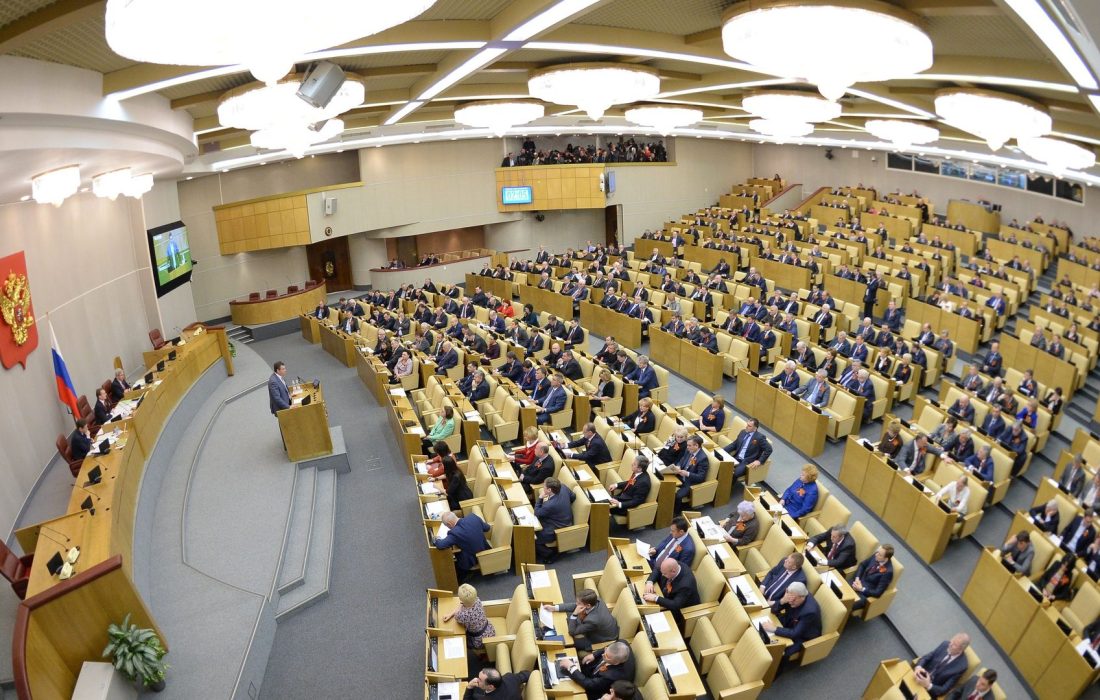
The first sitting on 30 September displayed the same combination of continuity and limited inclusion. Vyacheslav Volodin was elected speaker for a third consecutive term—the first time this had occurred in the post-Soviet State Duma. He received 406 votes, while Communist candidate Dmitry Novikov received 36.[10] Such a wide margin went well beyond United Russia’s own faction and showed that the established parties shared an interest in continuity at the head of the chamber. The opposition retained senior parliamentary offices, including the position of first deputy speaker for Communist Ivan Melnikov and vice-speaker positions for the other factions. In practical terms, the Duma began its work with familiar leadership and a broad procedural agreement over its internal organisation.
Continuity at the top was accompanied by substantial turnover below it. According to Volodin, 184 deputies—41 percent of the chamber—were new to the Duma.[11] This is a meaningful level of personnel renewal, but it should not be confused with a change in political direction. The leaders of all five factions were re-elected, Volodin remained speaker, and United Russia strengthened its control. The pattern is better described as renewal within continuity. New deputies can introduce professional knowledge, regional connections and different policy priorities, while the established leadership preserves coordination and institutional memory. For a governing system facing prolonged external pressure, this combination may be more useful than either complete stagnation or disruptive elite replacement.
The election of 46 participants and veterans of the military operation—41 of them representing United Russia—was the clearest sign of how the conflict has begun to reshape elite recruitment.[13] They account for just over 10 percent of the chamber. Their presence should not automatically be described as the militarisation of parliament; military backgrounds do not determine how every individual will legislate, and the cohort is unlikely to behave as a single faction. Its political meaning is nonetheless substantial. The state has created a visible route from military service into federal office, incorporating wartime experience into the political elite and giving veterans a direct role in legislation concerning social support, rehabilitation, defence and reintegration. The composition of the new Duma therefore links parliamentary renewal to one of the state’s most important current sources of public service and political legitimacy.
Taken together, these developments reveal the deeper meaning of adaptive consolidation. United Russia emerged strong enough to legislate without opposition support, yet the other parties were not excluded from parliamentary organisation. New deputies entered in significant numbers, but the central leadership remained in place. Veterans gained a visible institutional presence, while experienced political figures continued to manage the chamber. The system renewed itself without redistributing power away from the governing centre. This is more politically consequential than simple stagnation, but less transformative than a change of governing order.
The durability of this arrangement cannot be judged from seat totals alone. A very large majority can make legislation quicker and reduce the risk of institutional blockage. It can also weaken incentives for internal debate if electoral security is taken for granted. Opposition committee leadership may provide expertise and limited scrutiny, but only if disagreement is allowed to influence legislation before the final vote. The ninth Duma’s importance will therefore depend not simply on how loyally it supports the executive, but on whether it can identify policy failures, absorb regional concerns and manage the social and economic pressures created by a prolonged conflict. The election supplied the governing party with ample political room. How that room is used will determine whether consolidation produces adaptability or merely greater centralisation.
Conclusion
Russia’s 2026 State Duma election changed the scale of parliamentary power more than its basic direction. United Russia was expected to win, but the combination of 58.21 percent of the party-list vote, victories in 209 constituencies and a 349-seat elected majority gave the governing party its strongest parliamentary position to date. Turnout rose to 59.8 percent, and the increase in participation coincided with a larger—not smaller—share for United Russia. The result therefore points to successful mobilisation under wartime conditions, even though it cannot be treated as a precise referendum on every government policy or on the conflict itself.
The election also reordered the recognised opposition. The Communist Party weakened substantially, the LDPR and New People improved their positions, and A Just Russia became more vulnerable. Yet all five existing parliamentary parties returned to the chamber, and opposition factions continued to receive committee chairmanships and senior parliamentary posts. Russia’s parliamentary pluralism consequently survived, but within boundaries that leave the governing centre in firm control.
What changed most visibly was the combination of scale and personnel. The ninth Duma contains 184 new deputies and 46 participants or veterans of the military operation, but it remains under familiar leadership and within the same presidential political order. The election neither opened a path to alternation in national power nor amounted to an empty institutional ritual. It strengthened the governing majority, renewed selected parts of the elite and adapted parliamentary representation to wartime conditions. That is why “adaptive consolidation” offers the most balanced description of its outcome: continuity was preserved, but it was preserved through mobilisation, recruitment and controlled institutional change rather than through immobility alone.
References
- Central Election Commission of the Russian Federation. Resolution No. 53/356-9: On the results of the election of deputies of the State Duma of the Federal Assembly of the Russian Federation of the ninth convocation in the federal electoral district [Internet]. Moscow: CEC of Russia; 2026 Sep 25 [cited 2026 Oct 21]. Available from: https://www.consultant.ru/document/cons_doc_LAW_545294/
- Central Election Commission of the Russian Federation. Resolution No. 53/357-9: On the general results of the election of deputies of the State Duma of the Federal Assembly of the Russian Federation of the ninth convocation [Internet]. Moscow: CEC of Russia; 2026 Sep 25 [cited 2026 Oct 21]. Available from: https://www.consultant.ru/document/cons_doc_LAW_545293/
- Kurenev D. Results of the State Duma election in figures and charts [Internet]. Vedomosti. 2026 Sep 26 [cited 2026 Oct 21]. Russian. Available from: https://www.vedomosti.ru/politics/articles/2026/09/26/1232008-itogi-viborov-gosdumu
- RBC. How the State Duma elections ended: the main results [Internet]. 2026 Sep 25 [cited 2026 Oct 21]. Russian. Available from: https://www.rbc.ru/politics/18/09/2026/6aa940649a7947803fdcc142
- Maleva Y. None of the parliamentary parties disputed the overall election results [Internet]. Vedomosti. 2026 Sep 28 [cited 2026 Oct 21]. Russian. Available from: https://www.vedomosti.ru/politics/articles/2026/09/28/1232191-pretenzii-k-rezultatam-viborov
- Rykhlik N, Durandina E. How international observers monitored the State Duma elections [Internet]. Vedomosti. 2026 Sep 19 [cited 2026 Oct 21]. Russian. Available from: https://www.vedomosti.ru/politics/galleries/2026/09/19/1230190-kak-nablyudateli-sledyat-za-hodom-viborov
- OSCE Office for Democratic Institutions and Human Rights. Russian Federation continues to violate international commitments in a worrying pattern, failing to invite OSCE observers to parliamentary elections [Internet]. Warsaw: OSCE/ODIHR; 2026 Aug 6 [cited 2026 Oct 21]. Available from: https://odihr.osce.org/odihr/667020
- Sputnik Armenia. Russian State Duma elections held at a high level, says head of CIS observer mission [Internet]. 2026 Sep 21 [cited 2026 Oct 21]. Russian. Available from: https://am.sputniknews.ru/20260921/vybory-v-gosdumu-rossii-provedeny-na-vysokom-urovne–glava-nablyudateley-ot-sng-107112276.html
- Shoshina S, Lozovaya M. How many seats United Russia and the other parties received in the State Duma [Internet]. RBC. 2026 Sep 25 [cited 2026 Oct 21]. Russian. Available from: https://www.rbc.ru/politics/25/09/2026/6ab633d79a7947219cb1d9c2
- Maleva Y. “As we are, so is the Duma”: how the first meeting on Okhotny Ryad unfolded [Internet]. Vedomosti. 2026 Oct 1 [cited 2026 Oct 21]. Russian. Available from: https://www.vedomosti.ru/politics/articles/2026/10/01/1233255-pervoe-zasedanie-na-ohotnom-ryadu
- Kommersant. Volodin reported a 41% renewal of the State Duma following the election [Internet]. 2026 Sep 30 [cited 2026 Oct 21]. Russian. Available from: https://www.kommersant.ru/doc/8990313
- State Duma Television. The new State Duma will have 34 committees, 20 of which will be headed by United Russia deputies [Internet]. 2026 Sep 30 [cited 2026 Oct 21]. Russian. Available from: https://dumatv.ru/news/v-gosdume-novogo-soziva-budet-rabotat-34-komiteta–20-iz-nih-vozglavyat-deputati-ot-edinoi-rossii
- Vinogradova A, Maleva Y. Pamfilova: 46 participants and veterans of the special military operation elected to the State Duma [Internet]. Vedomosti. 2026 Sep 25 [cited 2026 Oct 21]. Russian. Available from: https://www.vedomosti.ru/politics/news/2026/09/25/1231793-izbrali-46-uchastnikov-spetsoperatsii