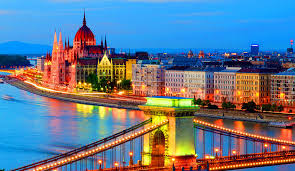

The Hungarian Parliament Building, known as “Országház,” is undoubtedly one of the most magnificent and technically precise examples of Neo-Gothic architecture in the world. This massive structure, situated on the eastern bank of the Danube River in the heart of Budapest, is not only the political symbol of the country but also considered an engineering and artistic masterpiece.
The idea for its construction took shape after the unification of the three ancient cities of Buda, Óbuda, and Pest via the Chain Bridge in 1873. To showcase its national authority, the Hungarian Parliament organized a grand competition for the building’s design, which was ultimately won in 1885 by a prominent architect named István Steindl with an innovative design.
The construction of this building took nineteen years, from 1885 to 1904, and Steindl unfortunately lost his sight before the work was completed. The dimensions of this structure are astonishing: it reaches a length of 268 meters and a width of 123 meters, while its sixteen-sided central dome stands 96 meters high, and the total area of the building covers approximately 18,000 square meters.
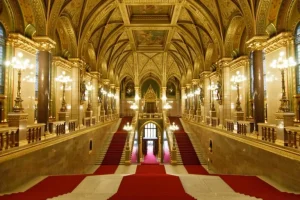
Stylistically, the exterior facade is heavily influenced by Neo-Gothic architecture and inspired by London’s Palace of Westminster, but the floor plan features Baroque symmetry, and the dome’s decorations are reminiscent of Neo-Renaissance architecture. This masterful fusion has turned the Hungarian Parliament into a unique masterpiece. To construct this building, forty million bricks, thirty thousand cubic meters of decorative stone, and approximately forty kilograms of 22 to 23-karat gold were used, which primarily manifest in the stucco work and interior decorations.
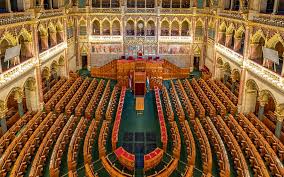
The interior space is divided into approximately 691 rooms, 27 entrances, 29 staircases, and ten courtyards. Its most prized section is the Dome Hall, at the center of which, under a glass enclosure, the Holy Crown of Hungary (the Crown of St. Stephen) is kept along with the royal sword and jewels. In this hall, there are sixteen statues of Hungarian rulers, and the walls and columns are covered with frescoes and golden decorations.
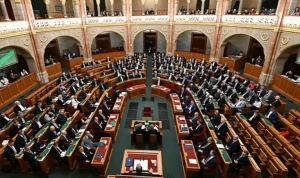
Interestingly, this structure was technologically very advanced for its time: in 1904, it was equipped with a mechanized ventilation system, elevators, electric lighting, and even a cooling system using blocks of ice. Today, this building is protected as part of a UNESCO World Heritage site, and since 2002, a massive project called the “István Steindl Program” has been launched for its complete restoration, which is expected to take nearly a decade, in order to both update the aging facilities and fully restore the building’s original glory. The Hungarian Parliament is not merely an administrative building, but a living museum of art, history, and human engineering prowess at the dawn of the 20th century.