Author: South Asia and Southeast Asia Studies Group, Institute for Iran-Eurasia Studies (IRAS)
Introduction
Maziar Mozaffari Falarti, Associate Professor at the University of Tehran and Head of the South Asia and Southeast Asia Studies Group
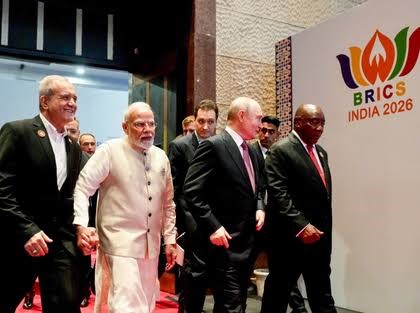
India’s assumption of the BRICS presidency in 2026 and its hosting of the 18th Summit in New Delhi unfold at one of the most intricate and consequential junctures in contemporary geopolitics. The expanded BRICS—encompassing nearly half of the world’s population and roughly 40 percent of global gross domestic product based on purchasing power parity—has transcended its origins as a conventional economic consultative club. Today, it stands as a focal arena for redefining global governance, development paradigms, technological frontiers, security frameworks, cultural exchanges, and environmental sustainability.
For New Delhi, presiding over BRICS in 2026 is far more than hosting a major diplomatic event. It represents an organic pillar of its grand strategy to consolidate its position as the preeminent “Voice of the Global South,” while systematically advancing its doctrines of “multi-alignment” and “strategic autonomy.” India endeavors to formulate BRICS not as a confrontational, anti-Western geopolitical bloc, but as a reformist and pragmatic mechanism grounded in international law. Within this conceptual architecture, soft power, cultural diplomacy, climate resilience, digital transformation, and urban diplomacy operate as vital instruments to recalibrate the international order.
The imperative of this strategic transition is twofold for the Islamic Republic of Iran, particularly against the backdrop of compounding regional crises and the acute necessity of restructuring its foreign relations. Official membership in BRICS can generate tangible national, economic, and developmental dividends only when the country’s policy apparatus moves beyond symbolic participation and diplomatic communiqués, embedding itself directly into specialized, institutional, and multilateral networking channels.
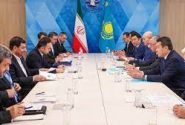
In this spirit, the present analytical dispatch synthesizes two complementary, firsthand field accounts from University of Tehran researchers who bring direct executive and policy-level experience to their academic inquiry. The first narrative examines the summit from a strategic and diplomatic perspective through the analytical lens of Dr. Omid Babelian, a researcher at the University of Tehran affiliated with the foreign affairs section of the Embassy of the Islamic Republic of Iran in New Delhi. Having directly accompanied official Iranian delegations during BRICS proceedings in India, he dissects India’s institutional doctrine, the recalibration of global governance, and the imperative for Iran to transition from mere political attendance to specialized functional influence. The second narrative explores the dimension of sustainable development and urban diplomacy through the field experience of Ali Saleh-Karimi, an environmental law and policy specialist and researcher at the University of Tehran, who participated in the specialized BRICS urban summit in Mumbai, known as the Mumbai First Conclave. His analysis evaluates the paradigmatic shift across the Global South regarding urban liveability, climate resilience, and untapped avenues for cross-border investment and technological transfer to revitalize Iran’s domestic infrastructure. Read in tandem, these contributions present a granular, unmediated perspective on “BRICS 2026 through India’s Reading,” demonstrating how wedding macro-diplomacy with environmental and urban specialization can open transformative horizons for Iran’s national interests.
BRICS in India’s Reading: Redefining an Order
Dr. Omid Babelian, Research Fellow and Representative of the Institute for Political and International Studies (IPIS) in India
India’s presidency of BRICS in 2026 cannot be evaluated merely as the routine hosting of an international summit. New Delhi has capitalized on this opportunity to project itself as a pivotal architect in shaping an evolving international system—an order that, in India’s estimation, must become genuinely multipolar while avoiding the zero-sum logic of bloc confrontation. The coordination of approximately 400 meetings and track events across nearly 30 Indian cities reflects this deliberate strategic posture. India effectively converted its BRICS presidency from a centralized diplomatic schedule confined to the capital into an expansive political, academic, commercial, cultural, and societal project. In doing so, it demonstrated that BRICS is not forged solely in intergovernmental negotiating chambers, but flourishes through dense networks connecting civil societies, universities, think tanks, private enterprises, and cultural bodies across member states. The fundamental question regarding India is therefore not merely what it seeks from BRICS, but what role New Delhi envisions for the grouping within the future architecture of world order. India’s answer is crystallized in its doctrine of strategic autonomy and its policy of multi-alignment. New Delhi does not view BRICS as a replacement for its extensive ties with the West, the G20, the Quad, or the Shanghai Cooperation Organisation; rather, it seeks an active seat at all these high tables to preserve its autonomy of choice. For New Delhi, BRICS is not an opposing camp facing an adversary, but one of the primary negotiating tables where the future order is actively designed.
One of the most nuanced aspects of India’s presidency is its deliberate reinterpretation of the BRICS acronym itself. Originally coined from the initials of Brazil, Russia, India, China, and South Africa to identify a cluster of emerging markets, the term in 2026 has been repurposed by India into a novel conceptual matrix that aligns the acronym with four core values: Building Resilience, Innovation, Cooperation, and Sustainability. The significance of this re-articulation extends beyond semantic ingenuity; it reflects a conscious effort to reshape the political identity of the grouping. New Delhi is actively working to transition BRICS from a historical country classification into a thematic and normative framework for international cooperation, ensuring the platform preserves its cohesion and functionality even as membership expands. In this reading, BRICS is no longer defined merely by which states are represented around the table, but by the shared vision and systemic governance they assemble to advance. Resilience, innovation, cooperation, and sustainability serve as India’s linguistic bridge across member states that possess divergent political structures, economic models, and geopolitical alignments. This conceptual reframing also enables BRICS to move beyond the perception of being a reactive, anti-status-quo entity toward functioning as an institutional source of collaborative solutions and collective capacity. India aims to shift the foundational question of BRICS from what the members oppose to what they can constructively build together.
Within this framework, a defining pillar of India’s approach is the recalibration of BRICS’ relationship with the existing international order. On the one hand, New Delhi remains a vocal critic of structural imbalances in global governance, the asymmetrical distribution of institutional power, and the underrepresentation of the Global South in multilateral bodies. On the other hand, India harbor no interest in converting BRICS into an instrument designed to dismantle the prevailing international system or construct an adversarial anti-Western alliance. In the Indian narrative, a foundational distinction exists between reforming an order and subverting it. BRICS can champion structural reforms within international institutions and expand the agency of developing nations while simultaneously upholding international law, multilateralism, and established global norms. Consequently, India envisions BRICS as a reformist guardian of international governance—a mechanism that, rather than supplanting one hegemony with another, adapts existing multilateral capacities to the realities of a shifting global distribution of power. This nuance is paramount for New Delhi, as it rejects the notion that a multipolar future should replicate rigid bloc rivalries under a different guise. For India, genuine multipolarity does not signify the partition of spheres of influence among major powers; rather, it entails broadening the agency, representation, and strategic choices available to diverse nations in global decision-making. Hence, in this conception, BRICS is not a disruptive force, but an indispensable instrument for recalibrating and balancing an order whose principles must be preserved even as its operational structures are reformed to accommodate emerging powers and the collective weight of the Global South.
This perspective is wholly consonant with India’s overarching foreign policy posture. New Delhi positions BRICS alongside its other multilateral commitments rather than in opposition to them. Simultaneous participation in the G20, BRICS, the Quad, the SCO, and various regional initiatives demonstrates that India refuses to anchor itself to any singular geopolitical camp. Preserving operational flexibility within an increasingly polycentric international environment remains New Delhi’s highest priority. For this reason, India resists the transformation of BRICS into an inflexible geopolitical bloc, recognizing that such rigidity would directly constrain the diplomatic maneuvering space it regards as vital. This logic becomes increasingly pertinent following the expansion of BRICS membership. As the group grows in size and encompasses greater political, economic, and regional diversity, generating common positions on sensitive geopolitical flashpoints becomes structurally more demanding. India’s resolution to this operational friction is to anchor cooperation around pragmatic, thematic issues where consensus is readily attainable, spanning energy security, advanced technologies, artificial intelligence, healthcare, trade facilitation, foreign direct investment, supply chain integration, regional connectivity, and sustainable development. In this context, Indian multipolarity is less a rigid geopolitical doctrine than a sophisticated methodology for managing diversity in the international system. New Delhi seeks a BRICS potent enough to shape the global architecture, yet sufficiently depoliticized to avoid setting its members against one another or against external powers.
From Iran’s perspective, this institutional re-articulation holds immense strategic value. Following its formal accession, Iran expanded its presence beyond high-level political summits to engage actively in cultural, academic, think-tank, and economic forums. Nonetheless, notable divergences persist between Tehran and New Delhi regarding the ultimate role of the bloc. While India views BRICS primarily as a mechanism to maximize diplomatic options and safeguard strategic autonomy, Iran values this dimension while also looking to the platform as an institutional shield to mitigate the structural pressures of unilateral sanctions and Western financial dominance. This difference in strategic emphasis must not become a barrier to cooperation; rather, it provides fertile ground to establish realistic, mutually beneficial areas of alignment. The record of India’s presidency demonstrates that the true potential of BRICS is not found in declaratory political communiqués, but in functional networks that generate collective capacity among member states. Critical arenas such as energy, digital technologies, artificial intelligence, transit connectivity, academic partnerships, public health, alternative financial instruments, supply chain resilience, and cultural diplomacy offer direct avenues for Iran to elevate its engagement from nominal political presence to specialized technical impact. The overarching takeaway for Tehran is unmistakable: membership in BRICS must evolve from attending conferences to embedding within the substantive processes of capacity building. It is precisely at this intersection that political accession matures into enduring strategic capital.
Ultimately, the core question of what India seeks from BRICS can be synthesized into a clear strategic doctrine: New Delhi envisions a BRICS that is larger in scale yet free from rigid bloc politics, more influential on the world stage yet non-confrontational in posture, dedicated to reforming the global order without subverting international law and multilateralism, and designed to generate shared institutional capacity rather than merely serve as a podium for systemic grievance. This fourfold vision represents the essence of India’s blueprint for the future global architecture. New Delhi seeks neither to erode international norms nor to entrench an obsolete structure that discounts the agency of emerging powers. The objective is to strike a sustainable equilibrium between continuity and transformation, established rules and institutional reform, structural power and democratic representation. In such an architecture, BRICS functions as an instrument facilitating the transition from a unipolar world toward a polycentric order without precipitating systemic conflict between rival alliances. Thus, the significance of BRICS for India is not confined to the aggregate demographic or economic weight of its members; its primary value lies in providing a venue to recalibrate relations among emerging powers, the Global South, and global governance institutions. The BRICS desired by New Delhi is an entity operating within international society to reform and balance the existing order from within.
Synthesizing India’s overarching posture reveals an unambiguous strategic message: New Delhi is guiding BRICS away from a consensus limited to what its members collectively oppose, toward a constructive partnership anchored in what they can collaboratively build. This operational reorientation constitutes the defining legacy of India’s presidency. If BRICS confines its mandate to lamenting systemic inequities, denouncing unilateralism, and critiquing global governance institutions, it will inevitably confront the same functional ceiling that has historically constrained many political platforms of the Global South—the chronic divide between assertive rhetoric and tangible deliverables. Conversely, if the grouping pairs its defense of international law and multilateralism with dense, institutional networks of cooperation across energy, technology, trade, scientific research, public health, cultural exchange, and infrastructure connectivity, it will emerge as a transformative architect of the twenty-first-century order. This represents the distinguishing hallmark of India’s strategic outlook: BRICS must not merely articulate a vocabulary of protest against the prevailing status quo, but must formulate the institutional language of practical cooperation to engineer a more equitable global order.
BRICS and the Emerging Urban Development Paradigm: From the Mumbai Conclave to Horizons for Iran
Ali Saleh-Karimi
Following an official invitation extended in July based on my research and policy experience across urban development studies, environmental law, water governance, and the housing sector, I attended the specialized BRICS proceedings convened in Mumbai on August 11–12. India’s decision to host this specialized conference focused on municipal management and environmental policy served as a strategic curtain-raiser for New Delhi’s thematic priorities ahead of the leader-level summit, underscoring its determination to redefine urban diplomacy and sustainable development as central pillars of South–South cooperation.
The core agenda of this specialized conclave centered on sharing and institutionalizing the governance models of “BRICS Friendship Cities” across sustainable urban growth, economic competitiveness, technological innovation, structural resilience, urban mobility, digital transformation, and intercultural exchange. A prominent dimension of the deliberations was the sustained emphasis on the environmental prerequisites of human settlements and habitat liveability. Critical discussions explored equitable access to freshwater reserves, the vulnerability of coastal local communities to climate disruptions, and the severe public health impacts of urban air pollution on community quality of life.
Observing the prominent BRICS member states—led by China and India, alongside Brazil, which has maintained an enduring commitment to international environmental governance since the 1972 Stockholm Declaration and the 1992 Rio Earth Summit—the presentations delivered by official delegations reflected a historical shift. Environmental policy, which for decades constituted a contentious battleground between the industrialized Western world and developing, post-colonial nations, has reached a fundamentally new threshold. The historical tensions that once characterized the Non-Aligned Movement and the Group of 77, where environmental concerns were frequently dismissed as external distractions from industrial catch-up, have been superseded by the accelerating ecological disruptions of recent decades. Today, leading developing powers view environmental sustainability and climate adaptation as existential domestic priorities that can no longer be reduced to Western political rhetoric, with climate change standing at the forefront of this transformed consensus.
This dynamic illustrates the expansion of environmental governance beyond pristine natural ecologies into the built realities of human habitats. The conclave’s intensive focus on urban living as an ecological imperative reflected the diverse challenges confronting BRICS societies, drawing attention to local community resilience, grassroots problem-solving, and the indispensable role of participatory governance. A central takeaway underscored by delegates was that public trust in municipal authorities constitutes the cornerstone of successful implementation, acknowledging that social cohesion is the ultimate foundation of ecological resilience. In an era where human life is predominantly urbanized—particularly across South and East Asia, the coastal hubs of Latin America, and rapidly growing urban centers in Africa—the concept of the environment has undergone a structural broadening from natural conservation to encompass social and urban habitats. This evolution accelerates the departure from the historic friction between development and conservation in the Global South, establishing a pragmatic paradigm shift that directly addresses environmental challenges through operational urban planning.
The robust presence of private sector leaders, industrial conglomerates, and non-governmental organizations alongside municipal officials in Mumbai demonstrated that BRICS is consolidating a vibrant new ecosystem centered on the urban economy. Within this architecture, elevating living standards is viewed not merely as a social welfare objective, but as an engine for cross-border capital investment in smart infrastructure, green mobility, and ecological engineering. An assessment of the prevailing discourse confirms that leading BRICS states regard the international transfer of municipal technologies and foreign direct investment as the linchpins of climate-resilient development. In this setting, Iran occupies an exceptional yet largely unleveraged position as a recent member, since the Iranian domestic market remains largely uncharted territory for Asian, African, and Latin American industrial actors. While this knowledge deficit presents an untapped landscape of commercial opportunity, that window risks rapid erosion if domestic economic diplomacy fails to act proactively.
To translate this environment into operational gains, Iran can structure its municipal cooperation priorities across several strategic pillars. In the realm of smart urban technologies, priority must be given to creating platforms for technology absorption and knowledge transfer in smart city infrastructure. In green industry and waste management, technical exchanges and technology transfer should target the circular economy and air pollution abatement. With respect to human-centric mobility, the emphasis lies on transitioning from car-dependent urban planning toward clean, mass public transit networks modeled after leading BRICS nations. Finally, in sustainable housing, Iran should cultivate supply chain partnerships and invite premier Indian and Chinese construction conglomerates to participate in urban regeneration and the provision of liveable housing.
Ultimately, the Mumbai conclave confirmed that urban diplomacy across the Global South has transcended ceremonial declarations to enter the domain of economic and environmental pragmatism. For the Islamic Republic of Iran, integrating into this multilateral ecosystem is not merely a diplomatic choice, but an urgent structural necessity to renew the country’s physical infrastructure. If Iran fails to capitalize on these emerging opportunities to rebuild its municipal foundations today, it risks becoming a passive bystander to regional developmental advances tomorrow, especially within an evolving BRICS framework where cities are no longer understood simply as residential settlements, but operate as dynamic engines of national power and transnational diplomacy in the twenty-first century.
Footnote References:
[2] BRICS
[3] G20
[4] QUAD
[5] Building Resilience, Innovation, Cooperation and Sustainability