
By: Behzad Ahmadi, Faculty Member at the University of Tehran and Member of the IRAS Scientific Council, September 2026
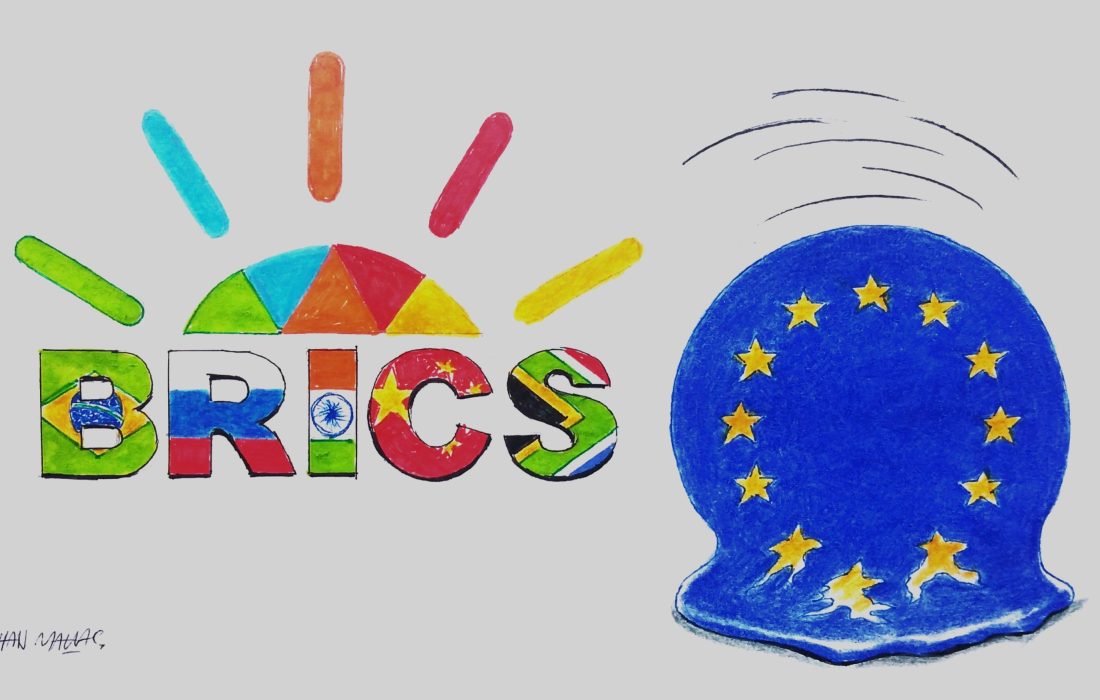
The BRICS summit in New Delhi, to be held on 12–13 September, is taking place at a moment when major crises in global politics are shaping its agenda. Military aggression against Iran has turned the security of the Persian Gulf and energy routes into a global concern; the war in Ukraine continues to define European security and Russia’s place in the international order; and competition between China and the United States has moved beyond trade and tariffs to advanced technologies, digital infrastructure, artificial intelligence, and the rules that will govern the future global economy. The New Delhi summit is being held at the intersection of these crises and is therefore of considerable importance to Europe.
BRICS matters to Europe because a large part of the world outside the Euro-Atlantic sphere no longer wishes to pursue issues of development, energy security, international payments, technology, and representation in global financial institutions solely through Western frameworks. This does not mean that a coherent anti-Western Front is emerging. BRICS currently has neither a common foreign policy nor binding decision-making rules, a single market, or a shared understanding of security threats. Yet it has become a platform through which states with highly divergent interests express their desire for greater strategic autonomy and reduced dependence on Western-dominated mechanisms.
Europe’s view of BRICS is therefore a mixture of concern and opportunity. The first concern is that BRICS may gradually become a vehicle for weakening the effectiveness of Western sanctions, particularly against Russia and Iran, and for expanding parallel channels for payments, trade, and financing. The second is China’s growing role in setting technological standards, shaping digital infrastructure, and influencing supply chains across the Global South. The third concern is political: Russia’s active presence in BRICS enables the Kremlin to demonstrate that pressure and isolation by Europe and the United States have not severed Russia’s global connections.
Europe, however, does not see BRICS solely as a threat. The group is also an important indicator of the Global South’s genuine demands. Calls for reforming quotas and voting rights at the International Monetary Fund and the World Bank, expanding access to development finance, objections to secondary sanctions and unilateral tariffs, and dissatisfaction with the concentration of technology and data cannot simply be reduced to Chinese and Russian policy. The joint statement issued by BRICS finance ministers and central bank governors ahead of the summit emphasized greater representation for emerging economies in global financial institutions, as well as the need for faster, cheaper, and more accessible cross-border payment systems (Reuters, 2026).
India is the most important variable for Europe in this context. New Delhi neither seeks to turn BRICS into an eastern version of an anti-Western alliance nor is it willing to define its interests solely through the prism of China’s and Russia’s rivalry with the West. While participating in BRICS, the Shanghai Cooperation Organisation, and other non-Western arrangements, India has simultaneously expanded its relations with Europe, the United States, Japan, and Australia. The logic of Indian foreign policy is to preserve multiple options and maximize room for manoeuvre, rather than align itself with a fixed bloc. This role has practical importance for Europe. On the one hand, India prevents China and Russia from fully steering BRICS in their preferred geopolitical direction; on the other, it does not wish to become an instrument of Europe or the United States in containing China and Russia.
India’s rotating BRICS presidency has been designed around this logic. New Delhi has sought to focus the agenda on economic resilience, trade, innovation, digital public infrastructure, artificial intelligence, financial technology, and scientific cooperation. This approach brings BRICS closer to becoming a forum for producing tangible and measurable benefits, rather than merely a platform for political protest against the West. India has clearly distanced itself from turning the debate on international payments into a project for the immediate displacement of the dollar. The stated objective is to expand the use of national currencies and reduce the costs of bilateral transactions through the interconnection of payment systems and central bank digital currencies, rather than create a common reserve currency in the near future (Bajpaee, 2026). Nevertheless, the gap between ambition and implementation capacity remains wide. Any effective linkage among payment systems requires technical interoperability, currency-swap arrangements, solutions to trade imbalances, and, above all, political trust among members. India–China rivalry, extensive sanctions against Russia and Iran, and security tensions among some newer members make this path difficult. From this perspective, Europe sees BRICS not as a rival that will soon displace the global financial system, but as a laboratory for the gradual development of alternative instruments. Even limited success in these areas could, over time, reduce the capacity of Europe and the United States to exert financial and sanctions-based pressure.
Iran is one of BRICS’s most important tests in New Delhi. Iran’s membership has made the group more prominent in West Asia and in debates over energy, sanctions, and maritime security, but it has not produced a unified political position. Iran naturally expects BRICS to demonstrate clearer support in the face of Western military and economic pressure. Yet India, China, Russia, and BRICS’s Arab members do not view the Iranian crisis in the same way. For China, energy stability and preventing the crisis from widening are paramount. For India, maritime security, energy imports, and the preservation of simultaneous relations with Iran, Arab states, and the West are decisive. Russia, too, sees the crisis within the broader framework of confrontation with the West, but it cannot alone shape a common BRICS position. Europe therefore does not expect BRICS to arrive at a common security policy on Iran. Its principal concern is rather that BRICS may gradually develop trade, payment, and technological-cooperation channels that mitigate the impact of sanctions.
Europe’s assessment of Ukraine is similar, though more sensitive. Russia’s presence at the New Delhi summit is a political gain for Moscow because it demonstrates that Russian foreign relations are not confined to Europe and the United States. But this presence should not be equated with collective BRICS support for Russia’s war. India, Brazil, and South Africa wish to maintain relations with Russia, but they are not prepared to subordinate their foreign policies to the Kremlin’s priorities. For Europe, this shows that the policy of isolating Russia has limits at the global level, while BRICS has not become a coherent Russian instrument for rewriting the rules of European security.
The more consequential issue for Europe’s future is the digital economy and artificial intelligence governance. These fields are no longer merely economic or technical matters. Cloud infrastructure, data, semiconductors, AI models, payment networks, and technical standards have become sources of power and strategic autonomy. In New Delhi, BRICS is seeking to elevate its role in these fields from that of a consumer of American and Chinese technologies to that of a participant in rule-making and infrastructure-building. This trend carries two messages for Europe. First, Europe faces a grouping that still lacks a unified regulatory framework for data protection, algorithmic transparency, corporate accountability, independent auditing, or AI safety. BRICS members hold different views: China emphasizes data sovereignty and state control; India emphasizes access and development; Russia focuses on resilience against sanctions; and other members prioritize technology transfer and narrowing the digital divide. This diversity limits BRICS’s capacity to produce comprehensive rules. Second, if BRICS succeeds in establishing a set of standards and practical instruments in areas such as digital public infrastructure, cross-border payments, data exchange, joint research, and AI capacity-building, it will affect global markets and rules over the longer term. The proposal discussed in India for an international mechanism to strengthen regulatory capacity in artificial intelligence, while still preliminary, indicates that the Global South seeks to be more than a passive recipient of American, Chinese, or European models in shaping the rules of this technology (Mehta & Roy, 2026).
India’s importance to Europe is once again particularly evident in this sphere. Europe has substantial experience and legal capacity in AI regulation and data protection, but faces a difficult competitive environment vis-à-vis the United States and China in infrastructure, computing capacity, platforms, and investment. India can promote more open, participatory rules better suited to the needs of developing countries within BRICS, while also serving as a bridge for issue-specific cooperation with Europe. If such cooperation focuses on system interoperability, open standards, supply-chain security, and AI risk assessment, it could move beyond the logic of bloc confrontation.
Ultimately, Europe sees BRICS not as a ready-made alternative to the Western order, but as evidence of a shifting distribution of power and changing demands for global governance. In this sense, the New Delhi summit is less a venue for announcing a new order than a setting in which the boundaries of the existing one become clearer.
References
Bajpaee, C. (2026, September 8). The India–China reset will continue at the BRICS summit. Chatham House. https://www.chathamhouse.org/2026/09/india-china-reset-will-continue-brics-summit
BRICS India. (2026). Building for resilience, innovation, cooperation and sustainability. https://www.brics2026.gov.in
Mehta, S., & Roy, R. (2026, September 10). BRICS summit is a moment for India to push for a global AI governance framework. The Indian Express. https://indianexpress.com/article/opinion/columns/brics-summit-ai-g20-10871939
Reuters. (2026, September 11). BRICS finance chiefs urge reform of global development financial institutions. https://www.reuters.com/business/finance/brics-finance-chiefs-urge-reform-global-development-financial-institutions-2026-09-11