
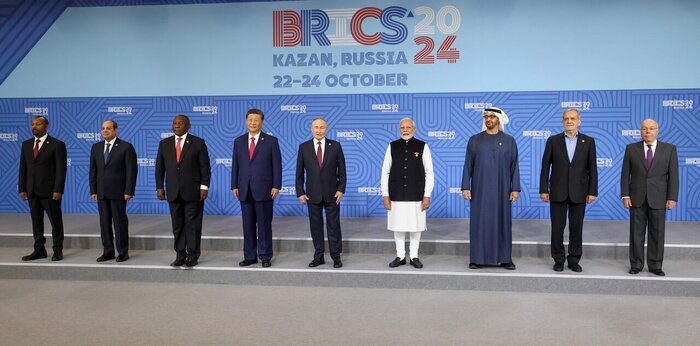
Author: Zakieh Yazdanshenas, Faculty Member at the University of Tehran and Head of the China Studies Research Group, Institute for Iran-Eurasia Studies (IRAS)
The 18th BRICS Summit is convening on September 12–13, 2026, in New Delhi under the Indian presidency. Assuming this year’s rotating chair, India has framed the summit under the theme of “Building for Resilience, Innovation, Cooperation and Sustainability[1].” Originally conceived to foster economic alignment among emerging markets, BRICS has progressively broadened its mandate across economic, financial, political, security, technological, and cultural domains. Through phased enlargement, it has evolved into a premier platform for collective action across the Global South, currently comprising eleven member states: Brazil, Russia, India, China, South Africa, Egypt, Ethiopia, Iran, the United Arab Emirates, Saudi Arabia, and Indonesia.
China’s Summit Objectives and the Role of BRICS in Beijing’s Grand Strategy
The 2026 summit holds multifaceted strategic significance for Beijing. In China’s calculus, BRICS provides an institutional springboard to consolidate South–South cooperation and amplify the collective voice of developing nations in shaping the emerging international order. The value of BRICS for China extends well beyond aggregated macroeconomic weight; the grouping functions as an institutional bridge linking Beijing with a broad spectrum of developing economies, creating room to harmonize non-Western positions on key international affairs.
From this perspective, BRICS enlargement offers China concurrent economic, political, and normative opportunities. Incorporating key regional powers from Asia, Africa, the Middle East, and Latin America has reinforced the bloc’s geopolitical standing within the Global South. China can leverage this platform to foster South–South development and recalibrate the representation of developing nations within global governance bodies. At the same time, the heterogeneity of national interests and strategic priorities among member states prevents the grouping from coalescing into a rigid political bloc. Consequently, Beijing’s strategic focus is less about engineering an overtly confrontational anti-Western alliance than consolidating BRICS as a flexible coordination platform for the non-Western world.
A central driver for Beijing is utilizing this institutional architecture to advance its broader global governance narrative. In recent years, China has articulated the “Global Governance Initiative[2],” grounded in five principles: sovereign equality, adherence to international law, multilateralism, people-centered approaches, and tangible deliverables. From Beijing’s perspective, global governance reform must prioritize expanding the agency of developing countries while restructuring legacy international architectures.
BRICS, characterized by its diverse membership and emphasis on South–South cooperation, provides an ideal institutional canvas to validate this narrative. China can present BRICS as proof of concept for an alternative multilateral model rooted in sovereign equality, consensus, and non-hegemonic engagement—a model Beijing frames as complementary to, and in certain domains an alternative for, Western-dominated institutional frameworks.
This normative dimension gains heightened traction amid the compounding legitimation crises confronting the liberal international order, exacerbated by recent armed conflicts and geopolitical volatility. Ongoing conflicts and their spillover effects on regional and international security—particularly maritime trade routes and energy transit—offer BRICS an opening to assume a more proactive posture on global governance, security, and sustainable development. In this setting, China seeks to position itself as a responsible major power committed to development, systemic stability, and multilateral dispute resolution.
The economic dimension of BRICS remains equally indispensable for Beijing. The expanded grouping commands critical leverage across global energy reserves, agricultural supplies, strategic minerals, consumer markets, and intermediate supply chains. Deepening intra-BRICS economic cooperation bolsters collective economic resilience, accelerates supply chain diversification, and diminishes exposure to external coercive instruments. The 2026 economic agenda centers directly on cross-border trade facilitation, alternative financing mechanisms, global value chains, and intra-bloc commercial integration.
Within this framework, substantial synergies emerge between the BRICS agenda and China’s “Global Development Initiative[3].” Focusing on poverty alleviation, narrowing developmental asymmetries, and revitalizing South–South technical cooperation, the initiative finds in BRICS an expansive multilateral vehicle for operationalization. Cooperative ventures across technology, digital infrastructure, and industrial capacity allow Beijing to pursue its developmental objectives within a collaborative multilateral framework rather than through purely bilateral channels, positioning BRICS as an institutional amplifier of its global initiatives.
Beyond development, BRICS has ventured into political and security dialogues in recent years, aligning with Beijing’s desire to cultivate coordinated responses to transnational security challenges and elevate the strategic agency of the Global South. Nonetheless, persistent divergences in strategic alignment and geopolitical priorities among member states—especially regarding sensitive regional flashpoints—continue to impose real structural limits on transforming BRICS into a coherent security mechanism.
Consequently, expansion presents China with an operational trade-off: an enlarged roster broadens the group’s global representation but inevitably increases the friction of consensus-building and agenda management. Beijing must continuously strike a delicate balance between providing strategic direction and avoiding perceptions of unilateral dominance or instrumentalization of the bloc.
Strategic Capacities and Opportunities for Iran
The strategic utility of BRICS for the Islamic Republic of Iran unfolds across political and economic levels. Politically, the 18th summit affords Tehran an institutional venue to project its narrative regarding recent regional confrontations and ongoing warfare before key developing powers. Active engagement within this forum reinforces Iran’s multilateral and bilateral diplomacy across non-Western capitals, elevating its diplomatic resilience.
Against the backdrop of geopolitical conflicts disrupting regional security, energy markets, and international maritime corridors, such multilateral venues assume elevated importance for Tehran. BRICS provides an institutional forum to deliberate the systemic fallout of these crises while articulating Global South perspectives on collective security and regional stability.
Economically, BRICS provides Iran with a functional pathway to access alternative markets and expand commercial partnerships outside Western-dominated networks. Collaborative programs spanning food security, industrial resilience, supply chain reconfiguration, and technological transfer carry distinct strategic utility for an economy confronting unilateral US sanctions. The geographic reach and structural complementarities of BRICS economies allow Iran to meaningfully diversify its external economic partnerships.
Financial integration represents another vital arena. Ongoing BRICS initiatives to expand local-currency settlement mechanisms, build interoperable cross-border payment architectures, and reduce reliance on Western financial clearinghouses provide tangible avenues to mitigate the constraints of financial sanctions. Realizing this potential, however, requires member states to transition political declarations into operational, technical banking instruments applicable to real trade flows.
Furthermore, the participation of China and other technologically advanced members opens avenues for technical and digital cooperation. China’s advanced capabilities in industrial infrastructure, artificial intelligence, and the digital economy are of direct relevance to Iran, providing alternatives to offset limited access to Western capital and dual-use technologies.
Despite these advantages, BRICS must not be viewed as a monolithic entity naturally aligned with all of Iran’s foreign policy preferences. Marked divergences in members’ economic structures, foreign relations, and geopolitical priorities mean that the tangible benefits for Iran will depend on the collective willingness of member states to translate political communiqués into actionable commercial and financial agreements. Ultimately, the true value of BRICS for Iran lies not in the creation of an anti-Western confrontation bloc, but in securing a decentralized network of political, economic, and financial opportunities to diversify the country’s foreign relations.
[1] Building for Resilience, Innovation, Cooperation and Sustainability
[2] Global Governance Initiative
[3] Global Development Initiative